

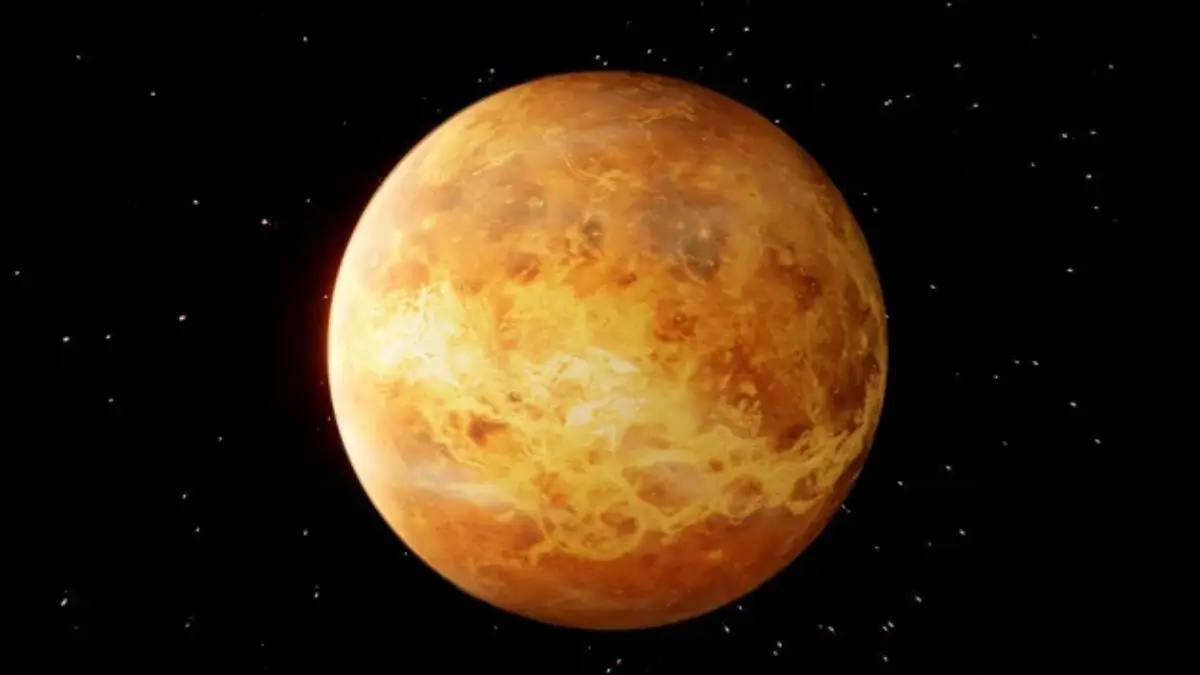
Venus, the second planet from the Sun, has gained attention due to its unique rotational behavior. As the only planet in our solar system that rotates clockwise, this phenomenon, known as retrograde rotation, is a subject of ongoing research. Recent studies aim to understand the implications of Venus's rotation on planetary formation theories and atmospheric conditions, making it a relevant topic for UPSC aspirants.
This topic is pertinent for UPSC Prelims as it intersects with questions on planetary science and solar system dynamics. For Mains, it relates to GS Paper I, particularly in understanding space phenomena and the formation of celestial bodies. A UPSC aspirant should study this topic to grasp the complexities of planetary motion and its scientific implications.
In our solar system, most planets rotate in an anticlockwise direction. Venus, however, spins in a clockwise direction, a motion termed retrograde rotation. This characteristic leads to unique phenomena, such as the Sun appearing to rise in the west and set in the east on Venus. The rotation period of Venus is approximately 243 Earth days, while its orbital period around the Sun is about 225 Earth days, resulting in a day longer than its year.
In the Prelims, questions may focus on factual aspects such as the rotation direction of Venus and its atmospheric conditions. Mains questions might delve into the reasons for its retrograde rotation, implications for planetary science, and comparative analyses with Earth and other planets.
The retrograde rotation of Venus poses intriguing questions about planetary evolution. Theories suggest that a catastrophic impact could have altered its rotational direction, while the planet's dense atmosphere might have contributed to gradual changes in its spin. Understanding these mechanisms enhances our knowledge of planetary resilience and adaptation, essential for studying celestial bodies.
Future research on Venus should focus on evidence-based policies regarding space exploration and planetary protection. Understanding Venus's unique characteristics can contribute to broader discussions about climate adaptation and ecosystem balance in planetary science. Additionally, insights gained from studying Venus may inform our approach to climate resilience on Earth.
Q1. Why does Venus rotate clockwise?
Answer: Venus rotates clockwise due to retrograde rotation, which may result from a massive collision or atmospheric effects over time, altering its original spin direction.
Q2. How long is a day on Venus compared to its year?
Answer: A single day on Venus, taking 243 Earth days to complete, is longer than its year, which lasts about 225 Earth days.
Q3. What are the atmospheric conditions on Venus?
Answer: Venus has extreme conditions, with surface temperatures around 470°C and atmospheric pressure about 90 times that of Earth, primarily composed of carbon dioxide and thick clouds of sulfuric acid.
Q4. What role does Venus play in planetary science?
Answer: Studying Venus enhances our understanding of planetary formation, atmospheric dynamics, and can provide insights into climate phenomena applicable to Earth.
Q5. Why is retrograde rotation significant?
Answer: Retrograde rotation challenges existing models of planetary formation and evolution, prompting scientists to explore alternative theories regarding celestial mechanics.
Question 1: Which planet rotates in a clockwise direction?
A) Earth
B) Mars
C) Venus
D) Jupiter
Correct Answer: C
Question 2: What is the primary reason for Venus's extreme surface temperature?
A) Proximity to the Sun
B) Dense atmosphere
C) Lack of moons
D) Slow rotation
Correct Answer: B
Question 3: How long does it take Venus to complete one orbit around the Sun?
A) 243 Earth days
B) 225 Earth days
C) 365 Earth days
D) 88 Earth days
Correct Answer: B
Question 4: What is retrograde rotation?
A) Rotation in the same direction as other planets
B) Rotation in the opposite direction of most planets
C) No rotation at all
D) Rapid rotation
Correct Answer: B
Question 5: Which of the following is a characteristic of Venus's atmosphere?
A) Nitrogen-rich
B) Oxygen-rich
C) Carbon dioxide-rich
D) Hydrogen-rich
Correct Answer: C
Question 6: What impact could a massive collision have on a planet's rotation?
A) Speed it up
B) Change its direction
C) Make it stop
D) Increase orbit size
Correct Answer: B
Question 7: Why is studying Venus important for understanding climate resilience?
A) It has many moons
B) It has extreme weather only
C) It offers insights into atmospheric dynamics
D) It is similar to Mars
Correct Answer: C
 Kutos : AI Assistant!
