

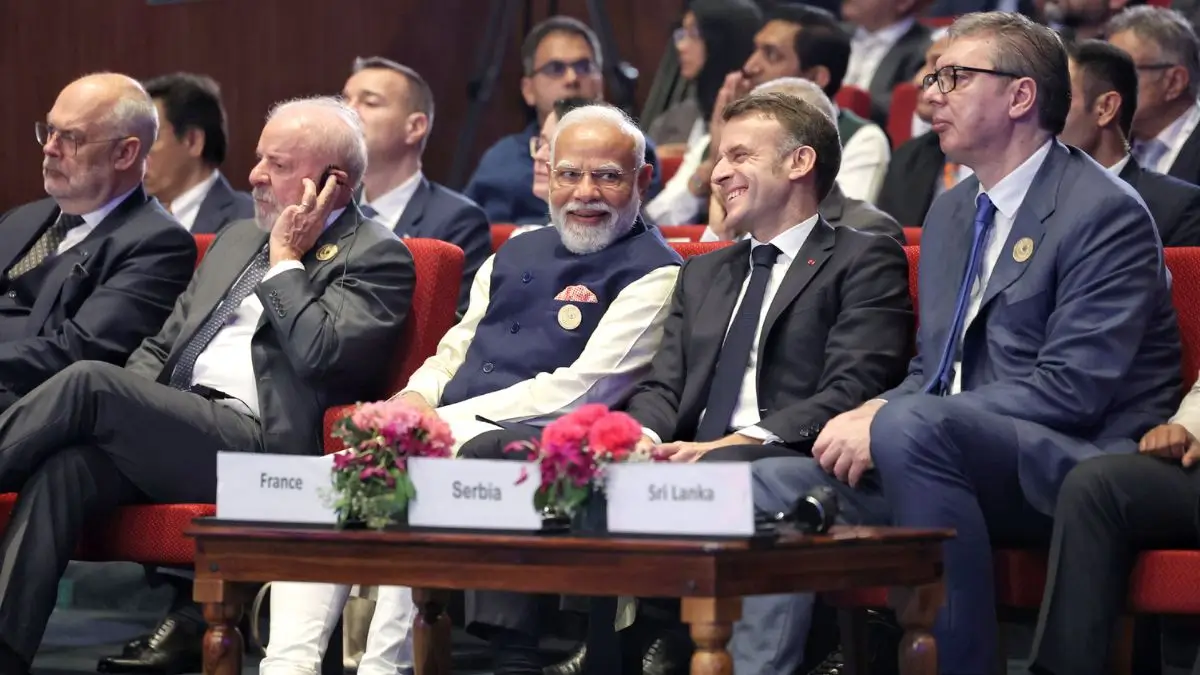
The India AI Impact Summit 2026, inaugurated by Prime Minister Narendra Modi, highlights India's role in shaping the future of Artificial Intelligence (AI). This summit is particularly relevant as it addresses global AI governance amidst rising concerns over ethical standards and equitable access to technology. With representatives from over 100 countries, the summit signifies India’s commitment to responsible AI development and its implications for global collaboration.
This topic has relevance for both UPSC Prelims and Mains. In Prelims, questions may focus on key terms and facts related to the summit, such as the M.A.N.A.V framework. For Mains, it falls under GS Paper III, specifically in the context of technology’s impact on society and governance. Understanding AI's implications is crucial for UPSC aspirants to engage in contemporary debates over technology and policy.
The India AI Impact Summit 2026 aims to promote a human-centric approach to AI, emphasizing ethical standards and inclusivity. The summit introduces the M.A.N.A.V framework, which stands for Moral and Ethical Systems, Accountable Governance, National Sovereignty, Accessible and Inclusive AI, and Valid and Legitimate AI systems. This framework is designed to guide AI development in a manner that is beneficial for all, particularly in developing nations.
In Prelims, questions may include definitions and facts about the M.A.N.A.V framework or the summit's objectives. In contrast, Mains may explore the implications of AI on governance, ethical standards, and societal impacts, requiring aspirants to analyze and critique India's approach to AI development.
The emergence of AI poses both opportunities and challenges. While it can enhance productivity and innovation, it also raises ethical concerns, particularly regarding data ownership and misinformation. The summit’s focus on responsible AI governance aims to mitigate risks associated with deepfakes and ensure that AI serves as a tool for societal enhancement rather than division. By democratizing AI, India seeks to prevent monopolization of technology and promote equitable access across nations.
Moving forward, India must continue to advocate for a sustainable and inclusive AI framework that prioritizes human welfare and addresses global inequities. Policymakers should focus on evidence-based strategies and international collaboration to ensure that AI evolves as a global common good, fostering resilience in economies and communities alike.
Q1. What is the significance of the India AI Impact Summit 2026?
Answer: The summit positions India as a leader in AI governance, emphasizing ethical standards and global collaboration in AI development.
Q2. What does the M.A.N.A.V framework entail?
Answer: The M.A.N.A.V framework focuses on Moral and Ethical Systems, Accountable Governance, National Sovereignty, Accessible AI, and Valid AI systems for responsible AI development.
Q3. How does AI impact the future of work according to PM Modi?
Answer: AI is expected to redefine work by enhancing collaboration between humans and intelligent systems, necessitating skilling and reskilling to adapt to new job roles.
Q4. What are the risks associated with AI highlighted in the summit?
Answer: Risks include deepfakes and misinformation, prompting the need for authenticity labels and global standards for safe AI use.
Q5. How can UPSC aspirants benefit from understanding AI governance?
Answer: Knowledge of AI governance prepares aspirants for questions on technology's societal impact, policy implications, and ethical considerations in the Mains exam.
Question 1: What is the M.A.N.A.V framework associated with?
A) Economic policies
B) AI governance
C) Environmental regulations
D) Health care reforms
Correct Answer: B
Question 2: Which country hosted the AI Impact Summit 2026?
A) United States
B) China
C) India
D) Japan
Correct Answer: C
Question 3: What does the term "democratizing AI" mean in the context of the summit?
A) Centralizing AI technology
B) Making AI accessible to all
C) Limiting AI to developed nations
D) Commercializing AI exclusively
Correct Answer: B
Question 4: Which of the following is NOT a component of the M.A.N.A.V framework?
A) Moral and Ethical Systems
B) National Sovereignty
C) Artificial Intelligence Monopoly
D) Accessible and Inclusive AI
Correct Answer: C
 Kutos : AI Assistant!
