

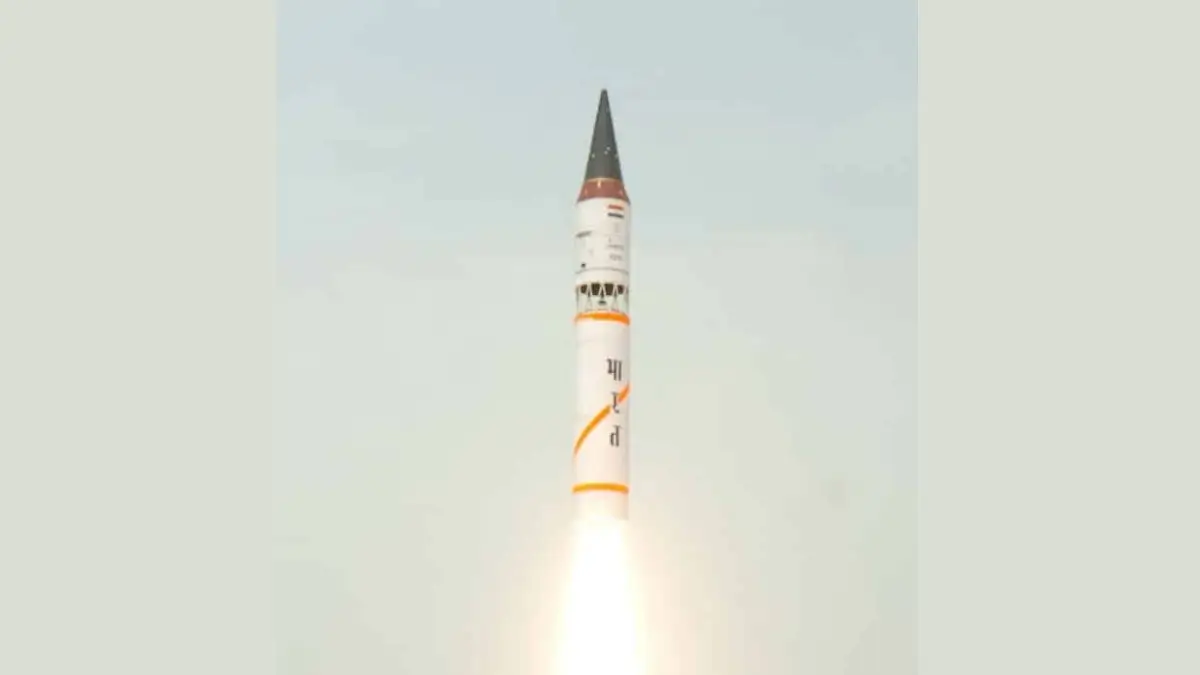
The recent test-fire of the Agni-III intermediate-range ballistic missile on February 6, 2026, highlights India's commitment to maintaining its strategic deterrence capabilities. This routine training exercise, conducted by the Strategic Forces Command at the Integrated Test Range in Chandipur, Odisha, is crucial for validating India's missile readiness amidst evolving geopolitical dynamics.
This topic is relevant for both Prelims and Mains preparation:
UPSC aspirants should study this topic to grasp the nuances of India's defense policies and its implications on national security.
The Agni-III missile, developed by the Defence Research and Development Organisation (DRDO), is a two-stage, solid-fuel ballistic missile with a range exceeding 3,000 kilometers. It is designed to carry both conventional and nuclear warheads, providing India with a flexible response mechanism. The successful test affirms the missile’s operational readiness and reliability, critical for India’s defense strategy.
In the Prelims, questions may focus on:
In the Mains, candidates might be asked to analyze:
The successful test of Agni-III reinforces India's credible minimum deterrence posturing. It ensures that India is prepared to respond to any threats, thus maintaining strategic stability in the region. The missile's reliability and range allow for effective deterrence against potential adversaries, thereby contributing to regional peace and security.
India must continue to invest in its missile technology for sustained strategic deterrence. An evidence-based policy approach that focuses on enhancing operational readiness and maintaining a credible deterrent posture is essential. This ensures resilience against evolving threats while adhering to principles of strategic stability and ecosystem balance in the defense sector.
Q1. What is the significance of the Agni-III missile?
Answer: The Agni-III missile is crucial for India's defense strategy as it enhances the country's deterrence capabilities with its long-range and nuclear delivery potential.
Q2. How does the Agni-III missile support India's No First Use policy?
Answer: The Agni-III provides credible second-strike capability, essential for maintaining deterrence without resorting to first use of nuclear weapons.
Q3. Why was the test conducted at the Integrated Test Range in Chandipur?
Answer: The Integrated Test Range offers advanced infrastructure and facilities necessary for testing missile systems and validating their performance under operational conditions.
Q4. Who manages the strategic missile programs in India?
Answer: The Strategic Forces Command is responsible for managing India's nuclear assets and ensuring the operational readiness of missile systems like Agni-III.
Q5. What are the key features of the Agni-III missile?
Answer: The Agni-III is a two-stage, solid-fuel missile with a range of over 3,000 kilometers, capable of carrying both conventional and nuclear warheads, enhancing India's strategic options.
Question 1: What is the range of the Agni-III missile?
A) 1,500 kilometers
B) 3,000 kilometers
C) Over 3,000 kilometers
D) 5,000 kilometers
Correct Answer: C
Question 2: Who conducted the recent test of the Agni-III missile?
A) Defence Research and Development Organisation
B) Indian Space Research Organisation
C) Strategic Forces Command
D) Ministry of Defence
Correct Answer: C
Question 3: What type of fuel does the Agni-III missile use?
A) Liquid fuel
B) Solid fuel
C) Hybrid fuel
D) Gas fuel
Correct Answer: B
Question 4: What is the purpose of the Integrated Test Range in Chandipur?
A) To develop new missile technologies
B) To conduct missile tests and validations
C) To store nuclear weapons
D) To train missile operators
Correct Answer: B
 Kutos : AI Assistant!
