

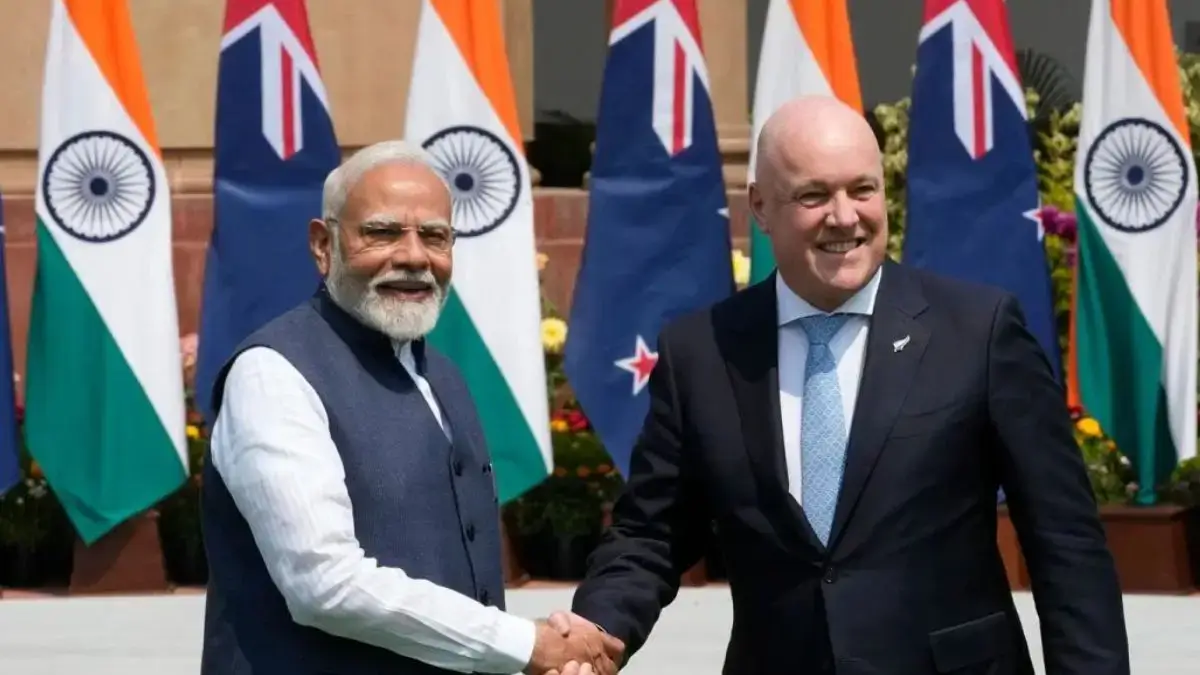
India and New Zealand have made a significant move to enhance their economic partnership by concluding negotiations for a comprehensive Free Trade Agreement (FTA). This milestone was announced on December 22, 2025, following a phone conversation between Prime Minister Narendra Modi and Prime Minister Christopher Luxon. The rapid conclusion of the talks in just nine months signifies a robust political commitment and a mutual ambition to strengthen bilateral trade, investment, and strategic collaboration.
Official sources indicate that the agreement is set to considerably deepen economic engagement between the two nations. One of the most notable aspects is the reduction or elimination of tariffs on 95% of New Zealand’s exports to India. The FTA aims to:
New Zealand anticipates that its exports to India could increase by $1.1 to $1.3 billion annually over the next twenty years due to this agreement.
Both leaders expressed optimism that the FTA would facilitate the doubling of bilateral trade within the next five years. Furthermore, New Zealand is projected to invest around $20 billion in India over the next 15 years, focusing on sectors such as agriculture, education, clean energy, technology, and food processing. For New Zealand, this agreement is expected to create more jobs, enhance wages, and expand opportunities, while India will benefit from better access to high-quality products, advanced technology, and global value chains.
The FTA supports several key national priorities for India, including:
This agreement aligns with India’s goal of becoming a developed nation by fostering trade-led growth and attracting long-term foreign investment.
With the conclusion of the India–New Zealand FTA, this marks India’s seventh Free Trade Agreement in recent years. India has also signed FTAs with:
This trend reflects India’s broader strategy of integrating with global markets while simultaneously supporting domestic growth.
Q1. What is the significance of the India-New Zealand FTA?
Answer: The India-New Zealand FTA is significant as it aims to enhance trade relations by reducing tariffs on 95% of exports, boosting bilateral trade and investment opportunities.
Q2. How long did the India-New Zealand FTA negotiations take?
Answer: The negotiations for the India-New Zealand FTA were concluded in just nine months, showcasing a strong political commitment from both nations.
Q3. What are the expected benefits for India from the FTA?
Answer: The FTA is expected to expand India's exports, integrate it into global supply chains, and attract long-term foreign investments, supporting its economic growth vision.
Q4. How much is New Zealand planning to invest in India?
Answer: New Zealand is projected to invest approximately $20 billion in India over the next 15 years, particularly in sectors like agriculture and clean energy.
Q5. What other countries has India signed FTAs with recently?
Answer: India has signed FTAs with several countries, including the UAE, Australia, UK, Oman, Mauritius, and EFTA countries, reflecting its strategy to enhance global trade ties.
Question 1: When was the India-New Zealand FTA announced?
A) December 22, 2022
B) December 22, 2025
C) March 2025
D) January 2025
Correct Answer: B
Question 2: What percentage of New Zealand's exports to India will have tariffs reduced or removed under the FTA?
A) 75%
B) 80%
C) 90%
D) 95%
Correct Answer: D
Question 3: How much is New Zealand expected to invest in India over 15 years?
A) $10 billion
B) $15 billion
C) $20 billion
D) $25 billion
Correct Answer: C
 Kutos : AI Assistant!
