

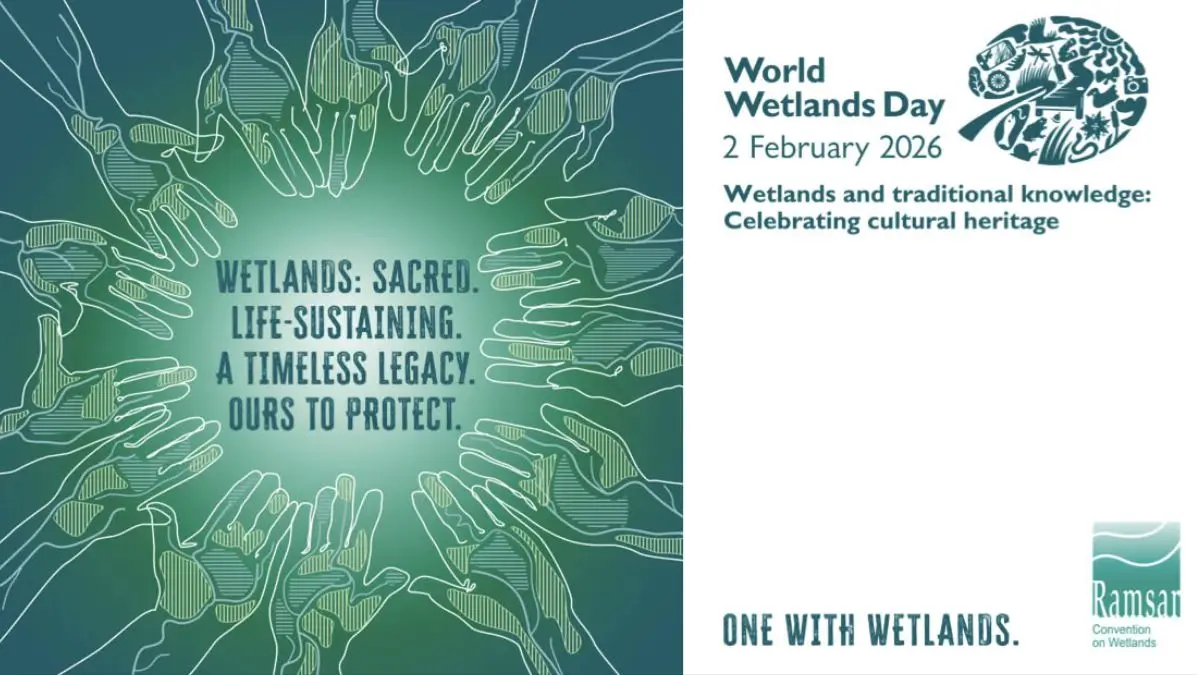
World Wetlands Day 2026 is observed on February 2, with a focus on the intersection of culture and community wisdom in wetland conservation. This year's global theme emphasizes the role of traditional and indigenous knowledge in protecting wetlands, which are increasingly threatened by modern development and climate change. Policymakers are reminded of the importance of integrating scientific understanding with traditional practices to ensure the sustainability of these vital ecosystems.
This topic is relevant for the UPSC Prelims as it encompasses environmental studies and current affairs. In the Mains exam, it relates to GS Paper III, focusing on conservation and sustainable development. Understanding wetland conservation is crucial for UPSC aspirants as it highlights the balance between ecological preservation and socio-economic needs.
World Wetlands Day is celebrated annually on February 2 to commemorate the signing of the Ramsar Convention in 1971. The day aims to raise awareness about wetlands—essential ecosystems that include lakes, marshes, mangroves, and floodplains. These ecosystems play a critical role in providing clean water, reducing floods, storing carbon, and supporting biodiversity. Despite their significance, wetlands often face neglect in development planning, making their protection a matter of human survival and sustainable development.
In the Prelims, questions may focus on definitions, categories of wetlands, and key statistics related to the Ramsar Convention. In contrast, Mains questions might explore the implications of wetland degradation, the significance of traditional knowledge in conservation, and the effectiveness of current policies.
The decline of wetlands leads to adverse effects on biodiversity, water security, and livelihoods. Traditional practices, such as seasonal fishing bans and sustainable harvesting, have historically contributed to ecological balance. Integrating these methods into formal governance can enhance conservation outcomes and resilience against climate change.
Moving forward, it is crucial to promote evidence-based policies that recognize the value of traditional knowledge in wetland conservation. Strategies should focus on enhancing community engagement and ensuring sustainable management practices. By fostering a holistic approach, it is possible to achieve ecosystem balance and address the pressing challenges posed by climate change.
Q1. What is the significance of World Wetlands Day 2026?
Answer: World Wetlands Day 2026 emphasizes the importance of traditional knowledge and community involvement in wetland conservation, highlighting their critical role in maintaining biodiversity and sustainable livelihoods.
Q2. Which international treaty governs wetland conservation?
Answer: The Ramsar Convention is the international treaty dedicated to the conservation and sustainable use of wetlands, promoting cooperation among contracting parties to protect these vital ecosystems.
Q3. How many Ramsar sites are there in India?
Answer: India has 98 Ramsar sites, making it the country with the highest number of Ramsar sites in South Asia, covering approximately 1.35 million hectares.
Q4. What are the Wetland (Conservation and Management) Rules, 2017?
Answer: These rules provide the legal framework for wetland protection in India, requiring states to identify wetlands, restrict pollution, and promote community participation in their management.
Q5. How can traditional knowledge aid in wetland conservation?
Answer: Traditional knowledge, developed through generations, offers effective and sustainable practices for managing wetlands, ensuring ecological balance while meeting community needs.
Question 1: What does World Wetlands Day commemorate?
A) The signing of the Kyoto Protocol
B) The signing of the Ramsar Convention
C) The establishment of UNESCO
D) The launch of the Paris Agreement
Correct Answer: B
Question 2: How many Ramsar sites are currently recognized in India?
A) 50
B) 98
C) 120
D) 150
Correct Answer: B
Question 3: What is the theme of World Wetlands Day 2026?
A) Wetlands and Climate Change
B) Wetlands and Traditional Knowledge
C) Wetlands and Urban Development
D) Wetlands and Global Warming
Correct Answer: B
Question 4: Which principle is emphasized by the Ramsar Convention?
A) Economic growth
B) Wise use of wetlands
C) Industrial expansion
D) Urbanization
Correct Answer: B
Question 5: What is a key feature of the Wetland (Conservation and Management) Rules, 2017?
A) Encouraging pollution in wetlands
B) Mandatory community participation
C) Complete removal of wetlands
D) Urban development in wetland areas
Correct Answer: B
 Kutos : AI Assistant!
