

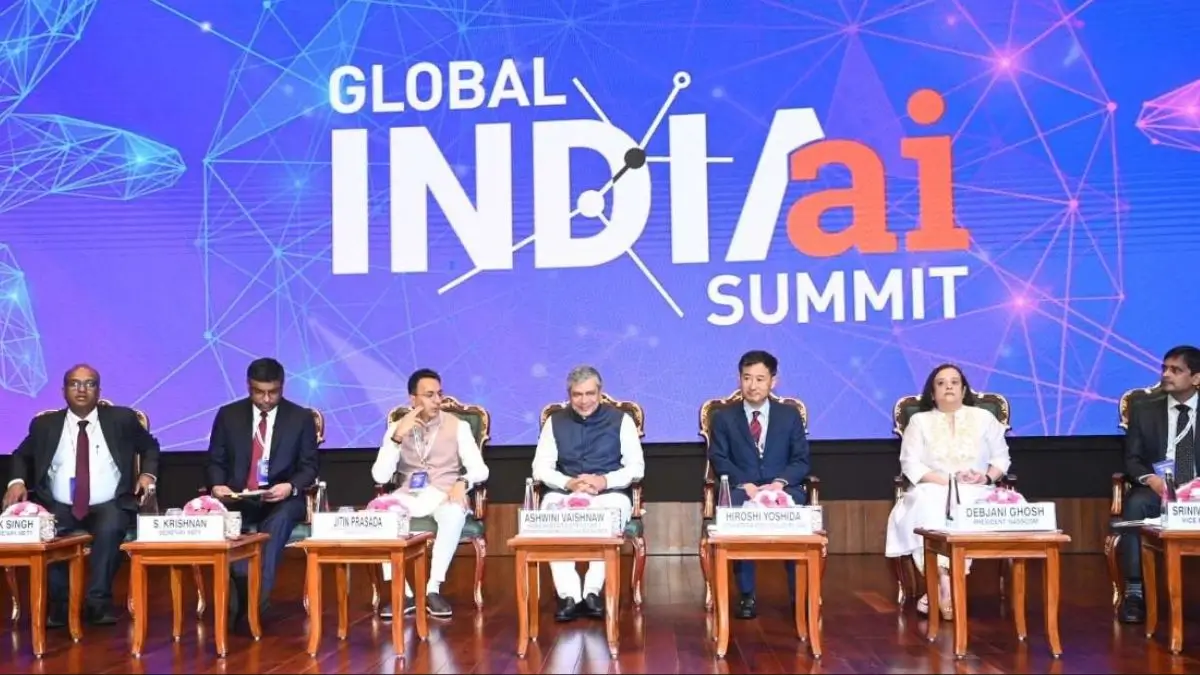
The AI Impact Summit 2026 is currently in focus as the Government of India prepares to unveil significant advancements in indigenous Large Language Model (LLM) and Small Language Model (SLM) technologies. Scheduled for later this week, the summit will showcase homegrown AI innovations from startups and government institutions, highlighting India's commitment to becoming self-reliant in AI capabilities.
This topic is relevant for UPSC aspirants as it intersects with various syllabus components, particularly in:
Understanding these developments is crucial for UPSC aspirants as they reflect India's strategic shift towards technological self-sufficiency and innovation.
Large Language Models (LLMs) are sophisticated AI systems trained on extensive datasets to perform language-related tasks, including text generation and comprehension. Conversely, Small Language Models (SLMs) are smaller, task-specific models designed for efficiency and usability on less powerful hardware. The emergence of indigenous LLMs and SLMs signifies a pivotal transition for India from merely utilizing foreign AI technologies to developing its own, thereby enhancing data sovereignty and reducing reliance on external resources.
In the Prelims, questions may focus on identifying key players and facts related to the AI Impact Summit and the technologies being launched. Mains examinations may explore the implications of these technologies on Indian society, the economy, and governance, prompting analysis of policy frameworks and implementation strategies.
The development of indigenous LLMs and SLMs has far-reaching implications. It not only enhances India's technological capabilities but also promotes a resilient ecosystem that prioritizes local languages and cultural contexts. This move can lead to improved governance through better adaptation of AI tools for local needs. Moreover, fostering an indigenous AI landscape aligns with national security interests by safeguarding data privacy and sovereignty, thus minimizing vulnerabilities associated with foreign AI reliance.
As India advances its AI strategy, it is essential to focus on sustainable practices that enhance the resilience of technological infrastructure. The AI Impact Summit 2026 represents a significant step towards establishing a robust AI ecosystem, fostering innovation, and ensuring that AI development is aligned with India's socio-economic goals. Policymakers must continue to support evidence-based initiatives to strengthen India's position as a global leader in AI innovation.
Q1. What is the purpose of the AI Impact Summit 2026?
Answer: The AI Impact Summit 2026 aims to showcase indigenous AI innovations, promote collaboration between startups and government, and strengthen India's AI ecosystem.
Q2. Why are indigenous LLMs and SLMs significant for India?
Answer: Indigenous LLMs and SLMs reduce dependency on foreign AI technologies, enhance data sovereignty, and better address local governance and cultural contexts.
Q3. How does the AI Impact Summit relate to UPSC exams?
Answer: The summit's focus on indigenous AI development is relevant for UPSC aspirants concerning technology policy and governance, particularly in GS Paper II and III.
Q4. What are the expected outcomes of AI data centres announced during the summit?
Answer: The establishment of AI data centers is expected to provide the necessary infrastructure for training LLMs and SLMs, enhancing AI capabilities across sectors.
Q5. What role does the government play in promoting AI in India?
Answer: The government promotes AI through funding support, policy frameworks, and initiatives like the AI Impact Summit to foster innovation and infrastructure development.
Question 1: What is the primary goal of the AI Impact Summit 2026?
A) To promote foreign AI models
B) To showcase indigenous AI technologies
C) To discuss AI regulations
D) To evaluate existing AI systems
Correct Answer: B
Question 2: Which organization is responsible for organizing the AI Impact Summit 2026?
A) Ministry of Science and Technology
B) Ministry of Electronics and Information Technology
C) Ministry of Home Affairs
D) Ministry of Education
Correct Answer: B
Question 3: What is a characteristic of a Small Language Model (SLM)?
A) Requires high computing power
B) Designed for specific tasks
C) Trained on massive datasets
D) Generates human-like text
Correct Answer: B
 Kutos : AI Assistant!
