

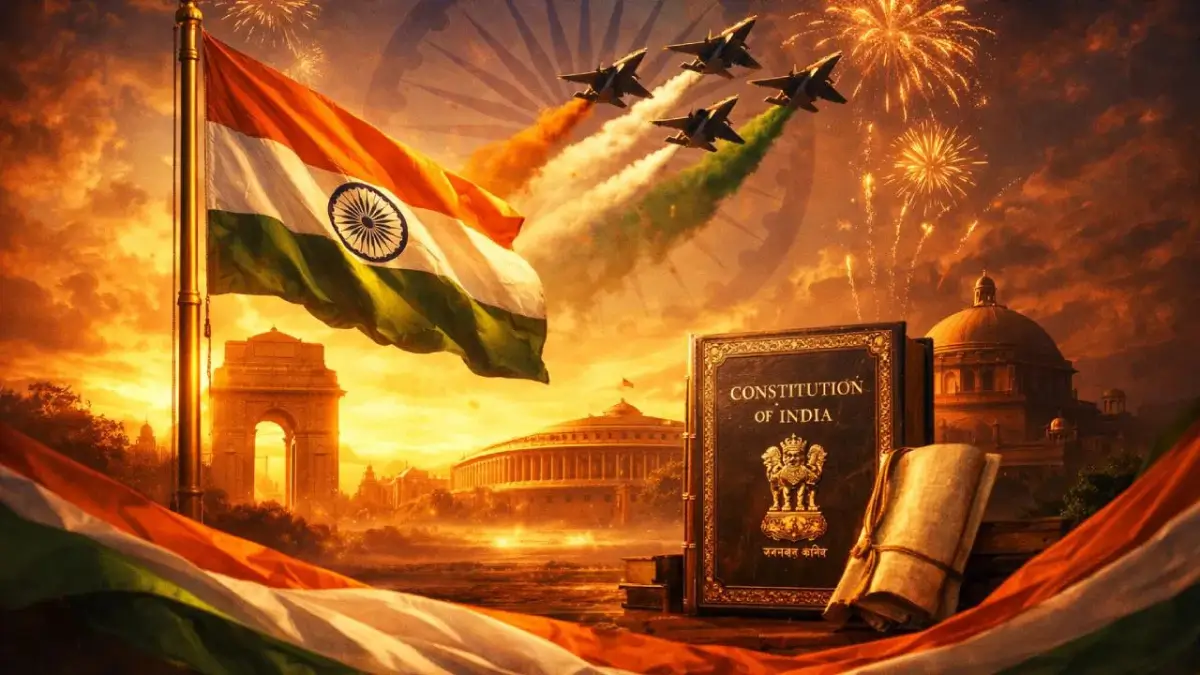
Republic Day, celebrated annually on January 26, is gaining attention as India prepares to mark its 77th Republic Day in 2026. This year prompts discussions on the historical significance of the Constitution of India, which came into effect in 1950, establishing India as a sovereign democratic republic. Understanding this day is essential for UPSC aspirants as it reflects India's governance evolution and constitutional framework.
This topic is relevant for UPSC Prelims and Mains. In Prelims, questions may focus on historical facts and dates related to Republic Day, while Mains questions could delve into its significance, the role of the Constitution, and democratic values. Specifically, it relates to GS Paper II, which covers governance, constitution, and the framework of Indian democracy.
UPSC aspirants should study this topic to grasp how the Constitution shapes India's democratic principles and the historical context surrounding its adoption.
India became a republic on January 26, 1950, when its Constitution replaced the British Government of India Act of 1935. This transition marked India’s shift to self-governance under a legal framework crafted by its own citizens. The choice of this date also commemorates the declaration of Purna Swaraj on January 26, 1930, emphasizing the connection between the freedom struggle and the country's constitutional governance.
In Prelims, questions may ask about the year India became a republic or significant figures like Dr. B.R. Ambedkar. Mains questions could explore the implications of the Constitution on Indian governance or analyze the evolution of democracy in India since independence.
The establishment of the Republic on January 26, 1950, marked a pivotal change in India's governance, emphasizing sovereignty and self-rule. This transition from colonial rule to a democratic framework has profound implications for India's political stability, societal values, and the rule of law. Understanding these developments helps analyze contemporary governance issues and the ongoing relevance of constitutional principles in India.
As India approaches its 77th Republic Day, it is crucial to reflect on the principles enshrined in the Constitution and their relevance in contemporary society. Emphasizing sustainability, resilience, and evidence-based policy can enhance governance and democratic practices. This reflection is vital for nurturing a well-informed citizenry that values constitutional rights and responsibilities.
Q1. Why is January 26 significant in Indian history?
Answer: January 26 is significant because it marks the day in 1950 when the Indian Constitution came into effect, establishing India as a sovereign democratic republic. It connects India's freedom struggle to its constitutional governance.
Q2. Who was the main architect of the Indian Constitution?
Answer: Dr. B.R. Ambedkar was the Chairman of the Drafting Committee and is often referred to as the chief architect of the Indian Constitution, which took nearly three years to complete.
Q3. What event does Republic Day celebrate?
Answer: Republic Day celebrates the adoption of the Constitution of India on January 26, 1950, which replaced the British Government of India Act, signifying India's self-governance.
Q4. How is Republic Day celebrated in India?
Answer: Republic Day is celebrated with a grand parade in New Delhi, showcasing India's military strength, cultural diversity, and technological achievements, along with the President hoisting the national flag.
Q5. What is the difference between Independence Day and Republic Day?
Answer: Independence Day on August 15 celebrates freedom from British rule in 1947, while Republic Day on January 26 marks the enactment of the Constitution in 1950, establishing India as a republic.
Question 1: When did India become a republic?
A) January 1, 1950
B) January 26, 1950
C) August 15, 1947
D) March 15, 1950
Correct Answer: B
Question 2: Who was the Chairman of the Drafting Committee of the Indian Constitution?
A) Mahatma Gandhi
B) Dr. B.R. Ambedkar
C) Jawaharlal Nehru
D) Sardar Vallabhbhai Patel
Correct Answer: B
Question 3: What does Republic Day commemorate?
A) Adoption of the Constitution
B) Independence from British rule
C) Formation of the first government
D) Establishment of the Indian National Congress
Correct Answer: A
 Kutos : AI Assistant!
