

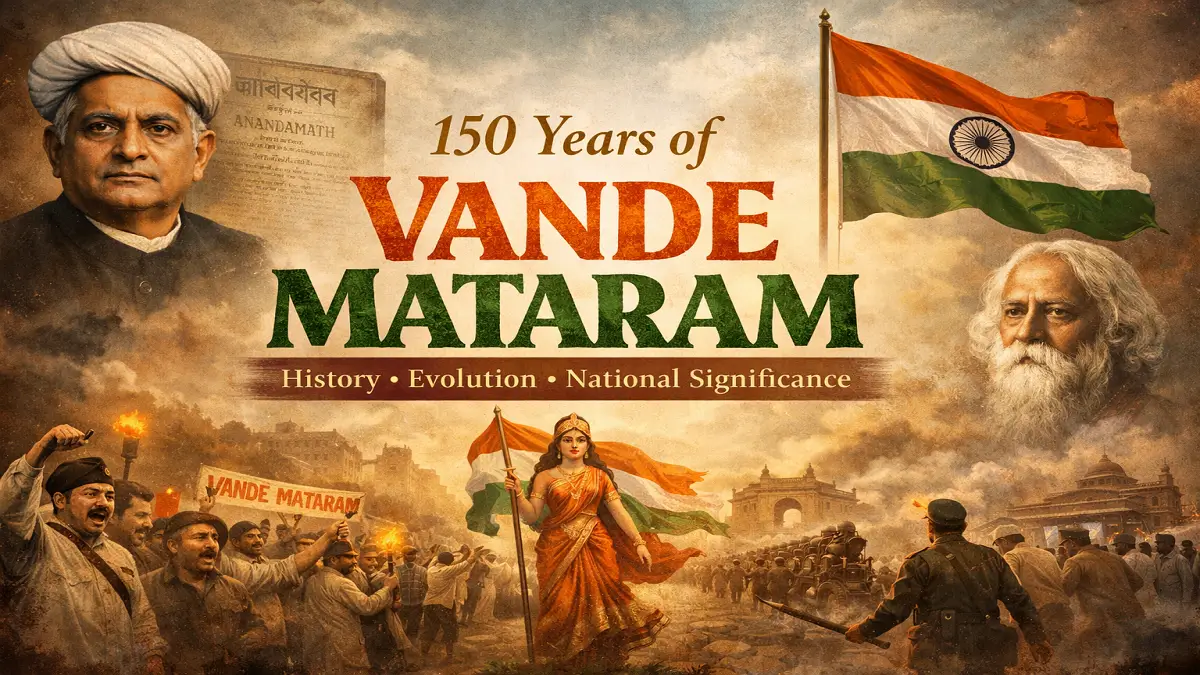
As India commemorates 150 years of Vande Mataram, it remains a pivotal symbol of patriotism and national unity. The song's historical roots and its role in India's freedom struggle are gaining renewed attention, especially in the context of ongoing discussions about national identity and cultural heritage. This relevance ties directly into the examination syllabus, prompting aspirants to explore its significance in both historical and contemporary frameworks.
For UPSC aspirants, Vande Mataram holds importance in both Prelims and Mains:
Understanding Vande Mataram is crucial for aspirants as it encapsulates the spirit of India's struggle for independence and the cultural ethos that shaped modern India.
Vande Mataram was composed by Bankimchandra Chattopadhyay around 1875 and gained prominence through its inclusion in the novel Anandamath. This hymn not only expresses devotion to the motherland but also served as a rallying cry for the national movement. The literary context presents a vivid depiction of India's struggle against colonial oppression, making it a crucial subject for examination.
In Prelims, questions may focus on factual details such as the date of composition, the author, and specific events related to its adoption. Mains questions will likely require analysis of its significance in the context of Indian nationalism, the socio-political implications of its use, and its enduring legacy in modern India.
Vande Mataram's evolution from a literary piece to a political slogan illustrates the cause-effect relationship between cultural expressions and national identity. Its use during significant political movements showcases its role in mobilizing diverse populations against colonial rule. Understanding these dynamics offers insights into broader themes of governance, national integrity, and cultural resilience.
As India moves forward, Vande Mataram continues to embody the ideals of resilience and unity essential for a diverse society. Its recognition in contemporary policy discussions emphasizes the need for an inclusive approach to national identity. For UPSC aspirants, a thorough understanding of Vande Mataram aids in grasping the intricate relationship between culture and politics, which is vital for effective governance and policy-making.
Q1. What is the historical significance of Vande Mataram?
Answer: Vande Mataram was composed in the late 19th century and became a powerful anthem during India's freedom struggle. It symbolizes patriotism and unity, serving as a rallying cry against colonial oppression.
Q2. Who composed Vande Mataram and when?
Answer: Vande Mataram was composed by Bankimchandra Chattopadhyay around 1875 and was popularized in his novel Anandamath published in 1881.
Q3. How did Vande Mataram influence the freedom movement?
Answer: Vande Mataram became a slogan for the freedom struggle, energizing protests and movements like the Swadeshi Movement and the anti-partition agitation in Bengal during the early 20th century.
Q4. When did Vande Mataram receive official recognition?
Answer: On January 24, 1950, Vande Mataram was recognized alongside Jana Gana Mana, reflecting its historical importance in India's struggle for independence.
Q5. What role did Vande Mataram play in fostering national unity?
Answer: Vande Mataram served to unify diverse groups in India, transcending religious and cultural barriers during the freedom movement, and continues to symbolize national unity today.
Question 1: Who composed the song Vande Mataram?
A) Rabindranath Tagore
B) Bankimchandra Chattopadhyay
C) Sri Aurobindo
D) Bipin Chandra Pal
Correct Answer: B
Question 2: In which novel was Vande Mataram first published?
A) Gitanjali
B) Anandamath
C) Chokher Bali
D) Pather Dabi
Correct Answer: B
 Kutos : AI Assistant!
