

The Chakrashila Wildlife Sanctuary in Assam has gained attention for its successful community-led conservation efforts, which have revitalized wild honey bee colonies and restored the surrounding ecosystem. This initiative underscores the significance of local participation in biodiversity conservation while promoting ecological balance.
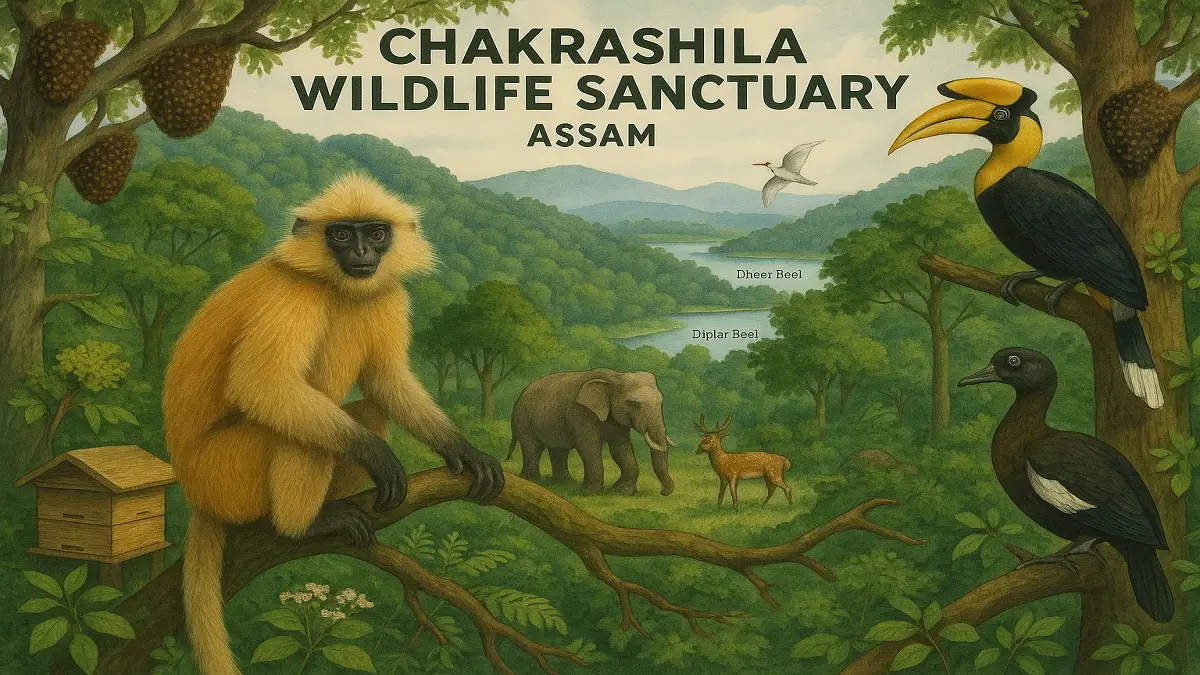
Local communities surrounding the Chakrashila Wildlife Sanctuary have taken proactive measures to:
The revival of honey bees has created a positive ripple effect on the ecosystem, enhancing pollination, fostering forest regeneration, and supporting various wildlife species. This initiative serves as a model for sustainable conservation, merging livelihood awareness with environmental protection.
Location: Kokrajhar and Dhubri districts, Assam
Area: 45.5 square kilometres
Terrain: Hilly landscape with dense forest cover
Established: Declared a wildlife sanctuary to protect regional biodiversity
Chakrashila is renowned as the second protected habitat for the endangered golden langur in India.
The sanctuary is home to over 600 golden langurs, making it one of the most crucial conservation sites for this endangered primate, which is endemic to parts of Assam and Bhutan. This status makes Chakrashila an important area often referenced in relation to endangered species in exams.
Two lakes integral to the sanctuary’s ecosystem are:
These water bodies:
The sanctuary supports a diverse range of forest types, including:
The dominant tree species is Sal (Shorea robusta), which plays a vital role in maintaining forest structure and providing habitats for wildlife.
The sanctuary hosts diverse wildlife, including:
Chakrashila is also significant for bird conservation, hosting several rare and endangered species such as:
This diversity underscores the sanctuary's importance for both mammalian and avian conservation.
Q1. What is the significance of the Chakrashila Wildlife Sanctuary?
Answer: The sanctuary is crucial for protecting endangered species like the golden langur and showcases successful community-led conservation efforts that enhance biodiversity.
Q2. How do local communities contribute to conservation in Chakrashila?
Answer: Local communities actively restore honey bee colonies, protect nesting sites, and reduce habitat disturbance, thereby supporting ecosystem health and biodiversity.
Q3. What types of flora are found in Chakrashila Wildlife Sanctuary?
Answer: The sanctuary features diverse forest types, including tropical moist deciduous and semi-evergreen forests, with Sal trees being the predominant species.
Q4. Which endangered bird species are present in Chakrashila?
Answer: The sanctuary is home to endangered species like the Bengal Florican and the White-winged Wood Duck, making it vital for avian conservation.
Q5. Why is Chakrashila a biodiversity hotspot?
Answer: Located in Assam, it supports diverse flora and fauna, including endangered species, and plays a key role in ecological balance and conservation efforts.
Question 1: What is the primary conservation success of Chakrashila Wildlife Sanctuary?
A) Increase in elephant population
B) Restoration of wild honey bee colonies
C) Establishment of new wetlands
D) Protection of agricultural lands
Correct Answer: B
Question 2: Which endangered species is primarily associated with Chakrashila Wildlife Sanctuary?
A) Bengal Tiger
B) Golden Langur
C) White-winged Wood Duck
D) Great Hornbill
Correct Answer: B
 Kutos : AI Assistant!
